
What Happens In An EMDR Session: Guide to the Process
By Kitty Ferguson-Mappus, M.S.S.W., LCSW-S · 12 min read
Starting trauma therapy can feel like standing at the edge of a dark room, you can’t see what’s inside, but you can feel it matters. If you’re curious about EMDR and also a little nervous, that makes sense and it is completely normal.
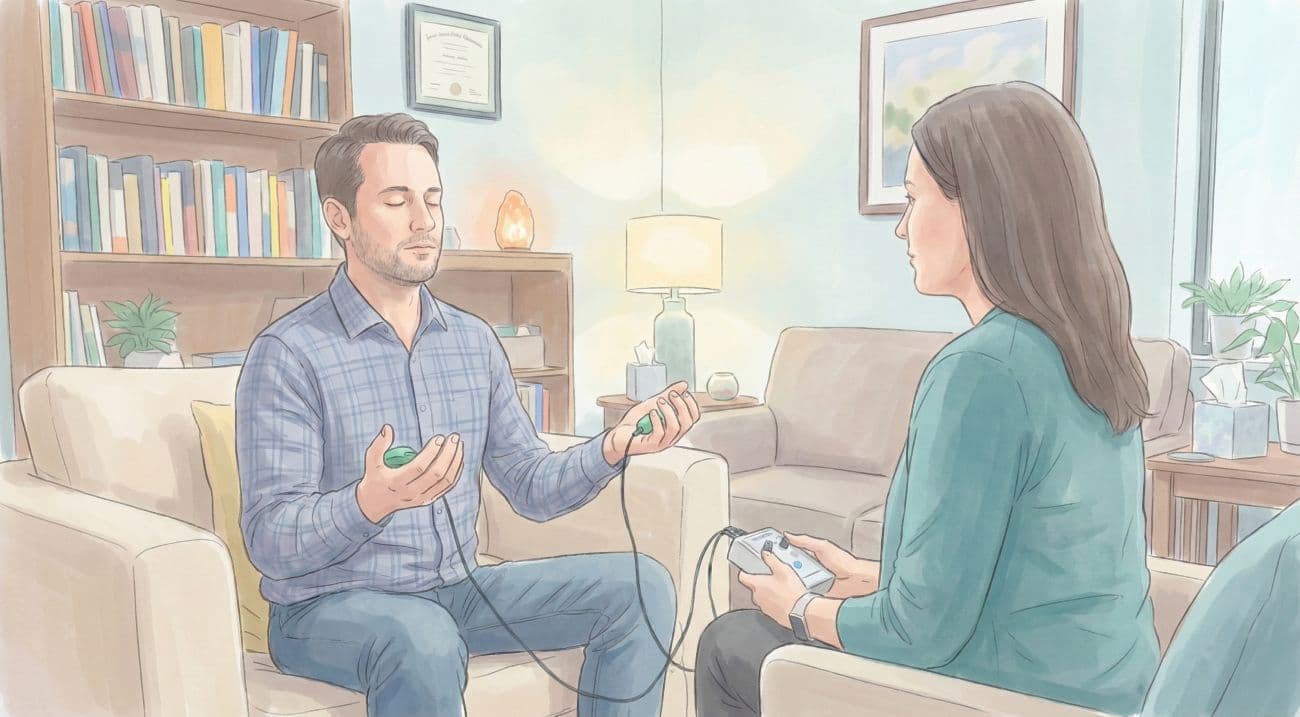
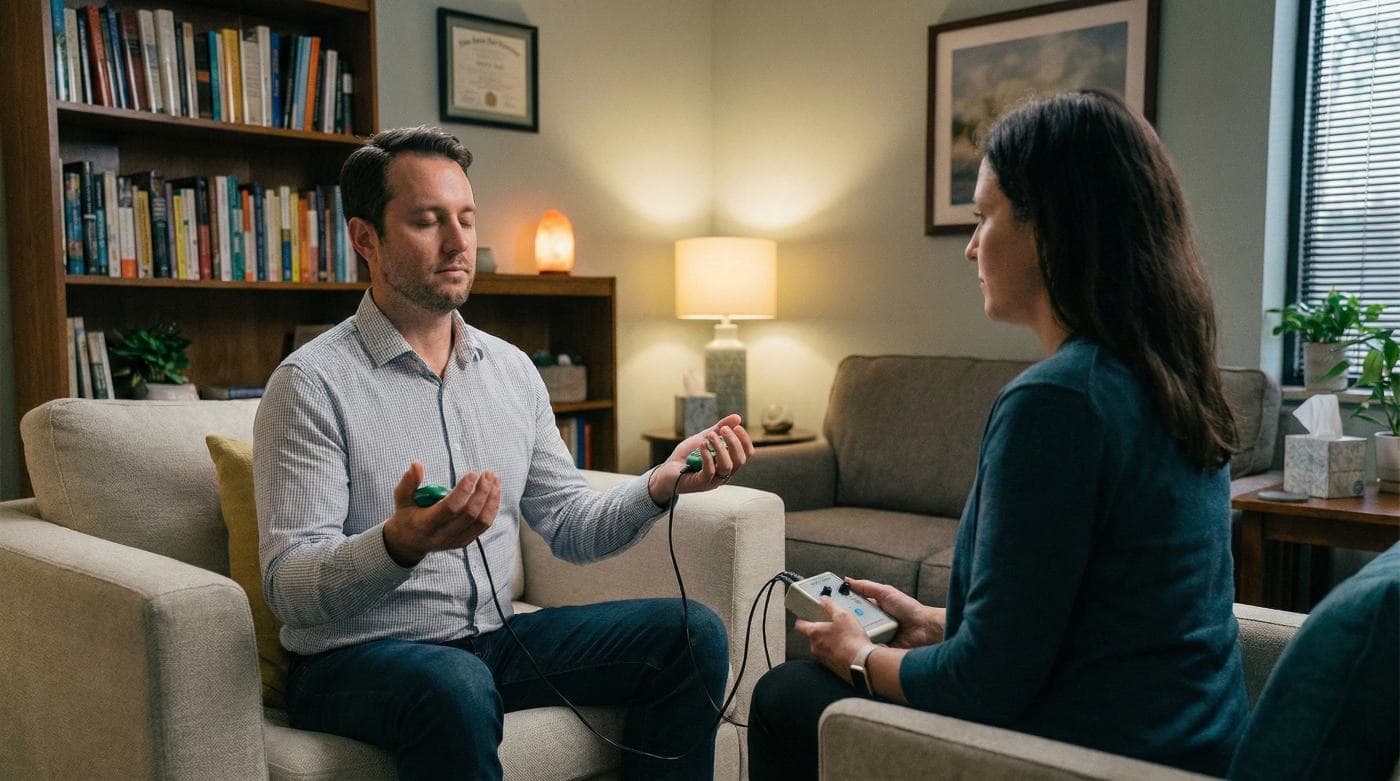
EMDR (Eye Movement Desensitization and Reprocessing) is a structured therapy that helps your brain reprocess painful memories so they stop hijacking the present. It uses bilateral stimulation, which can look like guided eye movements, alternating taps, or left right sounds through headphones.
If you’re wondering what happens in an emdr session, the short version is this: you stay awake, you stay aware, and you stay in control. Sessions follow a plan, safety is built in, and a good therapist won’t push you into hard memories until you are ready.
TL;DR: What Happens In An EMDR Session (quick summary)
- EMDR uses bilateral stimulation (eye movements, taps, or tones) while you notice what comes up.
- You can pause, slow down, or stop at any time. You are in charge of pacing.
- Many people start with preparation and calming skills before deeper memory work.
- A typical processing session includes a check-in, choosing a target, short stimulation sets with pauses, and a grounding closure.
EMDR basics in plain language, how it works and why it’s different

Think of traumatic memories like a song that keeps getting stuck on the same loud chorus. You might be doing the dishes, driving, or trying to fall asleep, and suddenly your body reacts like the past is happening again. EMDR, grounded in the adaptive information processing model, aims to help your brain untangle those knots through reprocessing within the memory networks so the volume turns down. The memory doesn’t vanish, it just becomes easier to hold. In simple terms, EMDR helps the brain update old, stuck memories so they feel less intense and less present-day.
This is one reason EMDR can feel different from standard talk therapy. You’re not only analyzing the story. You’re also working with how the memory shows up in your emotions and your body.
A few myths are worth clearing up early:
- EMDR isn’t hypnosis, and you can’t be controlled.
- You don’t have to share every detail of what happened.
- You won’t be forced to relive trauma at full intensity for the session to “count.”
Bilateral stimulation is the signature feature. Your therapist might choose eye movements, taps, or tones based on your needs, your comfort, and what helps you stay grounded. (If one method feels odd or activating, switching methods is common.)
EMDR is widely supported as an effective treatment for post-traumatic stress disorder in major guidelines and is also used for anxiety tied to a distressing event, disturbing memories, and some phobias. It isn’t the right fit for every situation, though. Extra care and more preparation time may be needed if you’re in a fresh crisis, dealing with active substance use, feeling unsafe in daily life, or having frequent dissociation that pulls you out of the present.
If you want a simple overview of how EMDR is used clinically, this page on EMDR therapy for healing trauma offers a helpful starting point.
What bilateral stimulation feels like (eye movements, tapping, or tones)
Bilateral stimulation usually happens in short sets, often 20 to 40 seconds at a time, followed by a pause. During the set, you might track the therapist’s fingers with your eyes in gentle eye movements (similar to rapid eye movement during sleep), feel alternating taps on your hands or knees, or hear left right tones.
Most people describe it as “strange but okay” at first. You’re doing something simple on the outside while your mind does something more complex on the inside. Some notice a gentle rhythm that makes it easier to stay with the process.
A key point: comfort matters. If eye movements give you a headache, taps might feel steadier. If taps feel too personal, tones might be easier. Therapists adjust pacing too. Faster isn’t always better, and slower isn’t always safer, it’s about what keeps you present.
What you do during reprocessing (and what you don’t have to do)
In EMDR, you’re not trying to “perform” anything. You’re practicing a noticing mindset. After each set, your therapist may ask, “What do you notice now?” You might report an image, a thought, an emotion shift, or a body sensation.
Some people talk a lot as they process. Others say only a few words, like “tight chest,” “anger,” or “I see the hallway.” Both are normal.
You also don’t have to force a memory or make it vivid. If your brain gives you fragments, sensations, or a sense of “something,” that can still be workable. And consent is ongoing. You can pause, slow down, change targets, or stop at any time.
EMDR therapy first session, what to expect and what you’ll leave with
The first appointment often feels more like planning than processing. If you’re searching for what to expect in your first EMDR therapy session, here’s the practical truth: many first sessions focus on safety, history, and goals, not diving into your worst memories.
You’ll likely handle paperwork (privacy, consent, and background forms). Then your mental health professional will ask about what brings you in, what symptoms you’re dealing with now, and what you want life to look like on the other side of treatment. Many EMDR intakes run 60 to 90 minutes, especially when the therapist wants enough time to answer questions without rushing you out the door.
You should leave session one with a clearer map. That might include a rough treatment plan, a sense of what EMDR will look like for you, and at least one tool to help you settle your nervous system between sessions.
If the trauma you’re carrying overlaps with PTSD symptoms, this page on trauma and PTSD support options can help you put words to what you’re experiencing.
Getting to know you, goals, triggers, and a plan that fits
Expect questions that connect the dots between past and present. During history taking, a therapist may ask about sleep, nightmares, panic, flashbacks, avoidance, irritability, startle response, shame, and body symptoms like nausea or tightness.
They’ll also ask about what helps: supportive people, routines, faith or meaning systems, movement, medication, creative outlets, and what’s worked (or not worked) in past therapy.
Then comes “target planning,” which is how EMDR decides where to start. Many people assume they must begin with the biggest trauma. Often, it’s safer and more effective to begin with a smaller memory that has the same emotional theme, like “I’m not safe,” “I’m powerless,” or “It’s my fault.” It’s like warming up a muscle before lifting heavy.
Stabilization tools you’ll practice before deeper work
Preparation skills aren’t a detour. They’re part of what makes EMDR feel safer, especially if big emotions show up after session. In the preparation phase, your therapist may teach a few core tools and practice these coping mechanisms with you, not just describe them.
Common examples include:
- A slow, steady breath pattern (like box breathing) to settle the body’s alarm system.
- Noticing what you see, hear, and feel in the room to remind your brain, “I’m here, not there.”
- Building a mental scene that helps your body soften, even if only a little.
- Imagining a secure place to “set aside” distressing material until the next session.
These tools don’t erase pain. They give you a way to ride the wave without getting pulled under.
The EMDR therapy phases explained, so you know what each step is for
If you like to understand the roadmap before you start driving, you’ll appreciate this part. The eight phases of EMDR help the therapist pace the work and help you stay within your window of tolerance.
Phases 1 and 2 often take a few sessions. Phases 3 to 8 repeat for each target memory, with safety and pacing built in.
Here’s a walkthrough:
- You and your therapist gather the big picture and identify possible targets.
- You build coping skills, learn the method, and create safety plans.
- You pick a target and name the negative belief, emotions, and body sensations.
- Bilateral stimulation helps the distress shift and lose intensity.
- You strengthen a more helpful positive belief, like “I’m safe now” or “I did the best I could.”
- You check for leftover tension or discomfort linked to the memory.
- You return to calm before you leave, even if processing isn’t “finished.”
- Next session, you check what changed and decide what comes next.
Phases 1 and 2, history and preparation (building safety first)
Some people worry that preparation means the therapist isn't doing EMDR. In reality, good prep is often what makes EMDR work well. It is also where your therapist determines whether it is safe to proceed with the other phases. This phase differs for everyone.
During this stage, your therapist watches how your nervous system responds to emotion, stress, and memory. You’ll practice grounding skills, talk about dissociation if it happens for you, and set clear rules for pacing.
If you have complex trauma, prep can take longer. Your brain and body sometimes needs to learn that therapy is a safe place to have feelings without getting overwhelmed.
Phases 3 to 8, the reprocessing loop (assessment through reevaluation)
Once reprocessing starts, sessions follow a steady arc. You choose a target, rate distress (often on a 0 to 10 scale), and begin stimulation sets with check-ins. Distress may spike, drop, change shape, or move into the body. Your therapist helps you stay in “dual awareness,” or dual attention, meaning part of you knows you’re in the office, in the present, and safe enough to observe what comes up.
As the distress lowers, the therapist supports installing a positive belief that feels true, not forced. Your therapist guides you through how you feel about the memory or target after the positive believe has been presented so judge if more work is needed on this memory or not. Your therapist will then walk you through closing down the session and making sure you are calm before the session ends. Re-evaluation at the next session and measures how you feel after some time has passed since reprocessing the target and time tells you and your therapist what held, what shifted, and what still needs care.
Once you’re in active processing, the structure of an EMDR therapy session can feel reassuring. Many people expect something chaotic, like opening a floodgate. More often, it’s controlled exposure with frequent grounding. You’re working with the memory, but you’re also staying connected to the room, the therapist, and your present-day self.
After session, people may feel tired, emotional, lighter, or have vivid dreams for a night or two. Triggers often start to hit less hard or pass faster over time.
If cost is part of your planning, this guide to EMDR therapy session costs in 2026 can help you set realistic expectations.
Common reactions during and after, and when to reach out
In the moment, reactions can include tears, shaking, warmth, nausea, yawning, a tight throat, or sudden anger. None of these automatically mean something is wrong. Your body is part of the processing.
After session, some people notice temporary effects like fatigue, emotional sensitivity, memory fragments, or vivid dreams. Gentle choices help, like hydration, a low-demand evening, light movement, and grounding. Some people like journaling afterwards, others prefer just leaving things until their next session.
Reach out to your therapist sooner if you notice any of the following:
- Your sleep falls apart for several nights in a row
- Panic won’t settle with coping tools
- You feel unsafe, or you have urges to self-harm
- Dissociation gets stronger or more frequent than usual
Those signals don’t mean EMDR “failed.” They mean the plan needs adjusting.
Safety and timing, is EMDR safe for complex trauma and how long does it take
Two practical questions come up in almost every consult: is emdr safe for complex trauma, and how long does emdr therapy take? The honest answer to both is, “It depends,” and there are reasons why.
EMDR has strong research support for post-traumatic stress disorder, and many clinicians use it for complex trauma as well. The therapy facilitates reprocessing of traumatic memories through eye movements and other bilateral stimulation. Safety comes from screening, pacing, and strong preparation. Timing depends on the type of trauma, how many targets there are, your current stress level, and what support you have outside therapy.
Single-incident trauma, like one car wreck or one assault, may take fewer sessions than long-term childhood trauma. Complex trauma often needs more resourcing, more work around dissociation, and sometimes a blended approach (for example, EMDR alongside parts work, somatic skills, or other trauma-focused therapy).
If you’re looking for a therapist with deep trauma training, it can help to read provider bios, like meet an EMDR-certified therapist, and notice how they talk about pacing and safety.
How therapists keep EMDR safe, especially with complex PTSD
Safety isn’t a single step at the start, it’s woven through the whole process. Therapists screen for current risks. They also pay attention to dissociation, memory gaps, and how quickly your nervous system escalates with physical sensations and emotional distress.
EMDR is meant to include dual awareness. You’re connecting with the memory, but you’re also staying oriented to the present. If you start to drift, the therapist may slow down, return to grounding, or shift to a smaller target.
Another safety point: you don’t have to describe every detail out loud. The work can happen with minimal words and you don't have to share details of the memory with your therapist. That can be a relief for people who fear being retraumatized by telling the story again.
What affects how many sessions you’ll need (and what progress can look like)
Rather than focusing only on session count, it helps to watch for real-life markers of change. Progress can look like fewer nightmares, less body tension, fewer “automatic” panic spikes, more choice in your reactions, and positive thoughts feel more real and true to you.
Many people with a single event may notice strong change in a smaller number of sessions once processing begins, though preparation time still matters. With complex trauma, it’s common for treatment to take longer, because there are more targets and more layers of meaning.
A useful reframe is this: you’re not just trying to feel okay when nothing happens. You’re trying to feel steadier when life does happen.
EMDR can be blended with other therapy styles (and that’s often a good thing)
EMDR is a full therapy approach, but in real life, many clinicians mix it with other methods to build the best plan for you. This is not a sign that EMDR is “not working.” It is often what makes treatment feel safer, more personal, and more sustainable.
A blended plan usually has one goal: help you process painful material without overwhelming your nervous system.
Here are a few common ways EMDR is combined with other modalities:
- Practical tools (sleep routines, coping plans, thought tools) can lower daily distress so you have more stability for EMDR work.
- If you feel trauma mostly in your body (tight chest, nausea, shutdown), a therapist may include body tracking, grounding, and movement-based regulation to help you stay present during processing.
- If you feel “split” inside (one part wants to heal, another part is terrified), parts work or IFS can build internal cooperation before targeting big memories. This is especially helpful with complex trauma and dissociation.
- For many people, the hardest triggers happen in relationships. A therapist may mix EMDR with relational work that builds safety, boundaries, and repair.
Sometimes the blend happens within the same session (a few minutes of grounding, a short processing set, then closure and meaning-making). Other times it happens across phases (several sessions of stabilization and skills, then a season of reprocessing, then integration).
If you are unsure what you need, a simple question to ask in a consult is: “How do you decide when to do EMDR processing, and when to slow down and use other tools?” A thoughtful therapist will welcome that question and explain how they tailor pacing.
Finally
EMDR is structured, paced, and built around safety, often starting by establishing a safe place. In an EMDR therapy session, you won’t be pushed into the deepest pain on day one, and you can slow down or stop at any point. With the right preparation and bilateral stimulation, sessions help shift a negative belief to a positive belief, so most reactions during and after are manageable, and they often come with a growing sense of relief.
If you’re considering EMDR, ask a therapist about their training, how they pace reprocessing, and how they support clients with complex trauma. Write down your questions now and bring them to a consult, because clarity is part of feeling safe enough to heal.
FAQ - Your Questions Answered
Do I have to describe my trauma out loud?
Not in detail. Many people share only a few words or a general label for the memory. A lot of the work can happen quietly inside you, and you stay in control of what you share.
What if I can’t remember everything clearly?
That is common. EMDR can still work with fragments, body sensations, emotions, or a general sense of what happened. You do not need a perfect, detailed memory for the process to be useful.
Will I lose control or get “stuck” in the memory?
A well-paced EMDR session is built around staying connected to the present. You can pause, slow down, or stop at any time. If you start to feel overwhelmed, your therapist should shift to grounding and help you feel steady again.
Can EMDR make you feel worse before you feel better?
Sometimes, yes, in a temporary way. You might feel tired, emotional, or have vivid dreams as your brain continues processing. If symptoms spike hard or you feel unsafe, that is a sign to contact your therapist so the plan can be adjusted.
How long is an EMDR session?
Many sessions are 60 to 90 minutes, depending on the therapist and setting. Longer sessions can help with having enough time for a calm closure, especially during active processing.
How many EMDR sessions do people usually need?
It depends on the type of trauma and how many memories need attention. Single-incident trauma is often shorter once processing begins, while complex trauma usually takes longer and includes more preparation and stabilization. A good therapist should give you a realistic range and revisit it as you go.
Is EMDR safe if I dissociate or “check out”?
It can be, but it needs extra care and pacing. A therapist may spend more time on preparation, grounding, and staying oriented to the room before doing deeper processing. If dissociation is common for you, bring it up early so it can be planned for.
Can EMDR be combined with other approaches?
Yes, and it often is. Many therapists blend EMDR with coping skills, body-based grounding, parts work, and relationship-focused support so the treatment fits you (not the other way around).